Saturday, March 23, 2019

2019: 52 Ancestors in 52 Weeks - Week 12 (12)

One of the suggestions for this week's topic of "12" is to write about the person in the #12 slot of an ancestorl chart.  In other words, one's mother's father's father.  In my case this would be John Schell, my Great Grandfather.

John Schell, the son of John Alexander Schell and Mary Jane Ross, was born January 13, 1867 in Innisfil Township, Simcoe County in Canada West.  He was their third child, but first son.   At the time of the 1871 Canadian census, the growing family of John Alexander and Mary Jane was living with his parents: Benjamin Schell and Mary McGill.  This discovery was beneficial to my genealogy research as I had grown up knowing the connection from me to John Schell.  Having previously confirmed that "my" John Schell was the son of John Alexander and Mary Jane, the census connected my Schell line through Benjamin Schell to the Johann Christian Schell who had settled in the Mohawk Valley area of New York state and married into the Petrie family, one of the Palatine families who settled in the Herkimer County area.  My Schell branch has been in Canada since around 1800 and in North America since the 1700s.


John Schell & Mary Deadman with oldest sons George & John
By the time of the 1881 census, John Alexander had relocated his family to a farm in Sunnidale Township in Simcoe County, with several of his siblings as neighbours.  As an adult, my Great-Grandfather John continued the family tradition of farm living in Simcoe County.  On April 24, 1894, he married Mary Deadman, daughter of George Deadman and Rebecca Gauley, in Stayner, Nottawasaga Township, Simcoe County, Ontario.  They lived on farms in Sunnidale and Tosorontio Townships before purchasing a farm in Brentwood, Sunnidale Township in early 1916.  John Schell bought the Brentwood farm from Thomas Bates, who is also one of my Great-Grandfathers.  Thomas's daughter Irene married John's son George in 1927.

Glencairn Union Cemetery, Glencairn, Ontario
John Schell died at the relatively young age of 49 years on May 24, 1916 of pernicious anemia - not long after having moved his family to Brentwood.  At the age of 42, his widow, Mary, was left to raise their ten children - the youngest being only six years old.  Their eldest son, George, was my grandfather and had just turned 21 and took over the responsibly of running the new family farm.  

The children of John Schell and Mary Deadman:
George (1895-1974) m. Martha Jane Irene Bates
John (1896-1933) m. Alice Evelyn Townsend
Maud (1899-1994) m. Isaac Spring Ambrose
Alfred (1900-1952) never married
Robert (1901-1994) m1. Mavis May Pearce ; 
                                 m2. Elsie Jean Terry 
William (1903-1991) m. Dorothy Foisie
Wesley (1904-1995) m. Nora Ellen Elizabeeth Jardine
Edward (1906-1970) m. Elizabeth Edna Holmes
Margaret (1908-1986) m. Albert Justing McBride
Stanley (1910-1966) never marrid
 
George eventually built a new house on the property and the original house torn down.  This newer house is the one I know from my childhood visits to my grandparents.  In the 1960s, my grandparents sold off most of the farm land, keeping a portion around the house to still do some vegetable gardening.  This portion of the John Schell farm is still in the family.  One of my first cousins and her husband have lived in the house for the past several decades, having raised their daughters there and now their grandchilden frequently visit.  More than 100 years later, the property is still in family hands.  Not bad for John Schell who had lived on several farms during his short life.  He managed to leave a legacy to his family.

Although I never met my Great-Grandfather John Schell, I grew up "knowing" him.  It was not always on display, but I do remember seeing the above photo as well as individual ones of John and Mary taken at the same photograph shooting.  My Mother would often reflect back on life in 1944, the year that her father George turned 49.  He was very superstitious and he was sure that he would die at the same as his father had.  The family was very relieved when he turned 50.  (He lived for another 30 years.)

Another story Mom often told was a comment her father would say about his father.  According to George, his father would comment that there was "music in the air, if only one was able to capture it".  The phonograph, radio and telegraph had been invented before his death, but I wonder what he would think of the world today?  Wifi, bluetooth, wireless and other modern technology pull not only music from the air but video as well.  And we are not bewildered by any of it.  We take it as a given and go through withdrawal when servers are down and we are unable to tweet, snapchat, facebook or text.

Thursday, March 7, 2019

2019: 52 Ancestors in 52 Weeks - Week 10 (Bachelor Uncle)

2019: 52 Ancestors in 52 Weeks - Week 9 (At the Courthouse)

2019: 52 Ancestors in 52 Weeks - Week 8 (Family Photo)

2019: 52 Ancestors in 52 Weeks - Week 7 (Love)

I've always been a great believer in love and am a romantic at heart.  My collection of romance novels will attest to that.  In my personal life, I was prepared to stay single than marry someone just for the sake of being married.  I did find my soulmate when I was in mid-30s and we will be celebrating our 24th wedding anniversary this year.  Family and friends still say we act like newlyweds.

As I continue to do my genealogy research, I am surprised at the number of males and females who never married.  Were they like me and were holding out for their true love and never found him/her?  Or was their story more tragic and they lost the Love of their Life before getting to the altar?  I will likely never get the answer to those questions. 

And then there are some that did get married later in life.  Did they "settle"?  Or did they finally find their True Love like I did?  There are many couples in my trees that lived into their 80s (which is something for people born in the 1800s and earlier) and celebrated their Golden Wedding Anniversary together. 

Mary Jane (nee Woodland) & William Daisley ALLEN
There is a family "heirloom" that has been used at Golden Wedding anniversaries for three generations of my Allen family.  The sign had been created in 1931 for the 60th Wedding anniversary of my great-grandparents: William Daisley Allen and Mary Jane Woodland. 
It was used again in 1970 for my grandparents' (Harry Allen & Gertie Cooper) 50th Wedding Anniversaries and then in 1997 for the 50th anniversary celebrations of two of their children: daughter Dora and her husband Fred McWhinnie and son Albert and his wife Helen Maloney.

When the Allens love, they love for a long time.

My father died before my parents were able to celebrate their 50th Wedding Anniversary.  However, my parents set the bar high for a loving relationship - which is why I believe I was not prepared to settle for less in my love life.

My parents (Jack Allen and Eveleen Schell) grew up in the same small Ontario hamlet: Brentwood, so they knew each other.  My father was six years older, so they were never went to school together - the community was large enough that the school house was divided into two rooms.  By the time my mother started school, my father would have been in the senior room.  However, several siblings of my father did attend school with my mother. 

By the time she was a teenager, my mother had set her sights on the local farm boy - but it took her several years before he gave in and paid her any attention.  It took a mutual friend to con him into double dating as the friend was interested in the school teacher that boarded at my maternal grandparents' house.  Although my father didn't pursue my mother, he apparently always made sure that he was dressed his best when hanging out at the local store with his buddies and "conveniently" ran into the local girls, including my mother. 

When they did become an item, Dad still played hard to get.  At church each Sunday, Mom would invite him to dinner and he always tried to use the excuse of farm chores to try to turn down the invitation.  Mom later learned from his sisters that he always made a point of doing his share of the chores in the morning before church, leaving the afternoon chores to his younger brothers.

Dad was a man of few words, but his actions spoke volumes.  He never left for work without a kiss from my mother.  He would not go to her for the kiss, but would stand at the back door waiting for her.  There was one year during my childhood that Mom was in and out of the hospital for several surguries: broken ankle, gall bladder and hysterectomy.  At that point in time, Dad's job as the Superintendent of a mechanical construction company required him to check in on various out of town job sites.  After driving for several hours each day, he would come home and cook the dinner I had prepped and then take my brothers and me to the hospital to visit my mother.  Once back home, he had paper work to complete before heading to bed and repeat the process the following day.

My Father died of pancreatitis in 1990 after only a few weeks of illness.  My Mother was devastated and wanted to give up the will to live.  But my brothers and I were able to get her to accept that he would have wanted to her continue with her life.  Dad's goal in life was always to provide a better life for his wife and children.  With his investments, insurance and pensions, Mom has been able to continue living without changing her lifestyle.

On the first anniversary of my father's death, my mother spent the day reading letters that he had sent her back in the days when they had been dating.  Prior to marriage, she worked as the Cook's Assistant in an Old Age Home and boarded at the home.  The man of a few words actully spent his evenings writing notes to his girlfriend.  They were more notes, but meant a lot to my mother - so much that she had kept them for over 40 years.  Even 29 years since my father's death, she still has them and refuses to let us read them.  She has requested that they be buried with her.

As Mom was adjusting to life as a widow, I began to realize that I was holding out for a True Love like I grew up seeing in my parents' relationship.  I eventually did meet my True Love and my husband has many of the qualities of my father.  Like my father, Terry's actions speak volumes.  We were together for several months before he acutally said the words "I love you" to me, but I was confident of my love from his actions.  He made been through a bad divorce, so I knew the words would be difficult for him but I knew I was loved.  Once he finally vocalized the words, he tells me several times a day.  And like my father, he will do anything for his wife without thought of himself.

2019: 52 Ancestors in 52 Weeks - Week 6 (Surprise)

What surprises have I encountered during my genealogy research?

I have already written about the surprise I had (aka "skeleton in the closet") when I found the marriage registration for my great-grandparents, Tom Bates & Pearl Mumberson.  They were married in January 1905 and their eldest daughter, my grandmother Irene, was born in June of that year.

Although I was surprised about that discovery, as I had never heard of the timing (unlike great-grandparents on my father's side who never hid the fact that their first born was less than nine months after their marriage) my biggest surprise was the ethnicity of my father's side of the family.

I grew up hearing stories of male family members being active in the Orange Lodge (Independent Order of Odd Fellows) and they would attend the Orangeman Parades on July 12th each year.  My mother tells of a story that when she mentioned to a cousin of my father's that she had never attended such a parade, his response was that she should be ashamed to admit that.  He did not take into account that her heritage was German (Mennonite), although her mother's side was British.

The Allens were staunch Protestant English and proud of their heritage.  I would avoid wearing green on St. Patrick's Day with the arguement that I would then be obliged to wear orange on Orangeman Day.


I had also been told my one of my aunts that the Family Bible indicated that the family had sailed to Canada from Liverpool England in July 1831 and settled in the Mono Township area of Upper Canada.  So naturally I assumed that the Allens were English and when I started researching, I discounted Allens from Ireland.

Lo and behold, one evening when I was searching on the internet (back in the early days no less), I came across a tree which included my father as well as his siblings and parents.  Although there were some errors and missing information on that tree, there was enough consistencies for me to accept that this tree was part of mine and provided me with the names of my great-greatgrandfather's parents and siblings.  All I had known was that Robert Allen had sailed from Liverpool at the age of 6 with his family - but I never had details as to the other family members.

As with any tree I discover online, I use the information as hints to do my own research to prove, or disprove that information.  My research led me to online communication with a woman who was actively doing research with the Dufferin County Museum.  Although not related to the Allens, she warned me that there had been several Allen families in the Mono Township area - some Scottish, some Irish and she believed my Robert Allen was the son of the Margaret Buchanan, wife of William Allen, native of Ireland, buried in the St. John's Cemetery, 7th Line, Mono Township.  In a later discussion with my aunt, she gave the exact wording from the family bible, indicating that the family was from Armagh Ireland.

So in my mid-30's I was surprised to discover that I was Irish not English!

Sunday, February 3, 2019

2019: 52 Ancestors in 52 Weeks - Week 5 (At the Library)

Week 5's topic of "At the Library" is well fitting for me as I spent 37 years working in academic libraries.  I started as a Student Assistant at Queen's University in Kingston, Ontario, Canada while I was still in high school and continued while a student at that university.  When I dropped out of university in my second year, I was hired on in a staff position.  During the next 10 years, I worked my way up through the ranks to a position of Circulation Co-ordinator of one of the libraries.  A few years later, I took a Leave of Absence to relocate with my husband in Regina, Saskatchewan and was hired to work in the Interlibrary Loans section of the John Archer Library at the University of Regina.  One of my junior positions at Queen's University had been in the Interlibrary Loans unit of the Health Sciences Library.  Needless to say my workplaces have served me well when I became obsessed with genealogy.

Working in an academic library system in the 1990s, I was in place to be on board with the explosion of personal computers and the internet as well as having the advantage of purchasing computers for home through payroll deduction.  The Documents unit of Queen's University Libraries is a depository for Government of Canada publications and the collection included microfilm of the Canadian census.  I spent many lunch breaks and after work time cranking through reels of microfilm.  The creation of Ancestry.ca was a God send to me as I could use its search engine to locate an image of the census rather than cranking the reels and then download that image to my computer. The microfilm readers I had access to at that time were not automated nor were they attached to a printer.  So when I had found an ancestor, I would have to hand write the information and then enter the data into my computer at home in the evening.

The Special Collections Unit at Queen's University houses various print documents relevant to genealogy research for Ontario.  If I wasn't checking microfilm in Documents, I was checking the Marriage records for Upper Canada, Canada West and Ontario in Special Collections.  Again, this pre-dates the availabilty of Ontario marriage records on Ancestry.

Working in Interlibrary Loan units gave me an understanding of how easily one may be able to obtain desired articles and books not available at one's home library.  I also understand the reason why not all material is available via Interlibrary Loan.  The library housing certain information has an obligation to have the material readily available to its prime users: university's staff and students in the case of an academic library and taxpayers at a public library.  In other words, library are not willing to loan Reference material to local patrons and definitely not via Interlibrary Loans which could make the item unavailable to others for at least a month.  Such material needs to remain in-house so it is available to patrons.  If extra copies, or older edition, of a book is also in the library's collection, it may be available to loan.  But has budgets continue to shrink, there is less and less duplication.

Although my only experience of providing reference assistance to faculty and staff was the years I was Co-ordinator of the Biology branch library, I am well aware of the importance to sourcing one's research and citing sources.  That knowledge had started in high school as one of my history teachers went out of his way to prepare us for writing university papers.  After having to return to the public library and try to relocate the books I had previously returned without properly recording the bibliographic information.  Never happened again: when I picked up a book, I recorded the details of the book; when I recorded a fact, I recorded the page number.  This practice has served me well for genealogy researching.

Another advantage of being a staff member at a university is access to online databases - either in the library, or accessing from home.  I was fortunate when I took an early retirement, I was able to retain my work email and have befinited greatly by accessing online newspapers.

Although I have never worked in a public library, I have certainly been a patron of my local public library.  When Ancestry started their Canadian domain, I subscribed to that but was reluctant to spend the extra for the American or British domains and made use of the Ancestry Library Edition at the public library.  But I quickly found it wanting: one had to book time on the library computer (or take one's chance of availability) and there was a two hour maximum (unless no one else had booked time on the computer).  And at this point in time, the only way to download a found image was to 3.5 inch floppy!  Do you know how many floppies I needed to take to the library each trip?  So I soon "bit the bullet" and upgraded my Ancestry subscription to World Deluxe and have never looked back.  I don't make daily purchases of coffee at my local coffee shop, so I use those funds to be able to download relevant records on the spot to my own computer as I research from the comfort of my home any time day or night - not when the public library is open and has an available computer.

In my hometown, the local branch of the Ontario Genealogy Society housed their collection in a wing of the main branch of the public library.  Before I moved away, I spent many a Saturday aand/or Sunday going through non-circulating books and entering data into my laptop.  How I wish I had a portable scanner back then.  I did make use of my scanner when I did a "field trip" to the Herkimer County Historical Society's Library.  After a full day, mostly scanning, I left with a lot of documentation, but only got through one folder of my Schell ancestors.  Unfortunately, I've never been able to make a return visit.

During my time in Regina, not only did I make use of relevant genealogy material at the univerisity library, I was also a frequent visitor to the public library as well as the Saskatchwan Genealogy Society's library located in Regina.  The Regina Public Library had a Prairie History Room full of genealogy material and the Librarian of that room co-ordinated a series of genealogy workshops during the winter months each Saturday.  One workshop was a field trip to the Regina location of the Saskatchewan Archives where we were given a behind the scenes tour.  The SGS Library housed a lot of Ontario related material as many prairie settlers had originated, or passsed through, Ontario before arriving in Saskatchewan.  My genealogy research greatly benefitted from my two years in Regina.

Obviously I am a great supporter of libraries for genealogy research.  Having experienced doing research before resources were readily available on the internet, I can appreciate the benefits of online research.  But one needs to realize that not everything has been digitized and does not need to be instantaneous.  The thrill can be in the hunt.  There are also benefits to having access to a librarian or library technician/clerk. (Yes, not all library employees are librarians.)  Google (or Bing, etc) is not a true replacement for a reference person.  For simple questions, maybe, but for more indepth assistance one needs the human interaction.  By talking to a volunteer at the Herkimer County Archives Library, I was handed a large file folder of acticles and documents pertinent to my ancestor.  If I had tried to investigate the library on my own, I would have wasted a lot of valuable time - even in the one room research facility.  Library staff are able to offer valuable, informational workshops for a nominal fee, or even free, as it is considered part of their regular job and not their source of income.  Not that I'm discounting the value of genealogy professionals and the work that they do, but if one is lucky enough to live in an area that offers genealogy workshops at their local library, go for it!

SUPPORT YOUR LOCAL LIBRARY!

Tuesday, January 29, 2019

2019: 52 Ancestors in 52 Weeks - Week 4 (I'd Like to Meet...)

During the past decade, my husband and I have moved back and forth across Canada three times due to his work.  The first two were arranged and paid for by his company while the last one was arranged by us and only subsidized by his company.  With each move, as our household and personal things were packed up and transported, I always wondered what prompted my ancestors to relocate - not just from one province to another, but across an ocean and without the modern convenience of air travel and professional movers.  One move took me back closer to my elderly mother and other family members, but two moves did take me away from my relatives.  With having experienced the pain and agony of leaving family, I again always wondered how my ancestors managed, emotionally, to leave family members behind in the homeland with the knowledge that they would likely never to see them again.

The ancestor I would like to meet is my Third Great Grandmother, Isabella Margaret (nee Greer) Bates McKee.  She was born about 1822 in Ireland and died in 1878 in Ontario Canada.  She married Thomas Edward Bates in 1843 in Ireland.  Their first son, my great-grandfather, William was born the following year in Ireland.  In 1846, the young family departed their homeland for Canada.  Although I have not been able to verify with primary documentation, folklore claims that Thomas died during the voyage aross the Atlantic Ocean and Isabella was pregnant with their second child who was born after the widow arrived in Canada.  She named that son Thomas Edward.

The young widow Bates was likely not totally alone with a toddler and newborn as her parents may have been emigrating with them at the same time.  As I have not been able to locate passenger or immigration records, I am only assuming that at this point in time.  The 1861 census for Canada West does show the two young Bates boys living with their maternal grandparents (William John Greer and Marthy Charleton) in Mulmur Township in Simcoe County.  I have not yet located any of the family in the 1851/52 census.  Isabella was not in the household in the 1861 census as she had remarried in the early 1850s to Robert McKee and was living with him elsewhere in Mulmur Township.

I would like to meet Isabella to hear her stories as to her experiences deciding to leave her homeland with husband and son only to arrive in her new land as a widow and about to give birth to her second child.  I can only hope that the family had indeed been travelling with her parents so that she had their support during that time.

I would also like to meet Isabella to ask why her sons were living with her parents rather than with her and their step-father.  What was her life like with her second husband?  Was he a controlling man who refused to have sons from his wife's previous marriage live with them?  Did circumstance find that the teenage boys were better off living with their grandparents?   The grandparents would have been in their 70s and would have benefited from having the teenagers living with them to do the farm chores, but the household also included a married son and his bride.  Or was it just a case that the Bates brothers had been visiting their grandparents at the time of the census?  The 1861 census also listed two granddaughters in the household.  They were daughters of another son, not the son also in the household.

I am interested in knowing Isabella's story.  Why did she make the life decisions she did make and what were her thoughts about how life treated her.  I feel that I am a strong, independent woman and the more I research my family history, I find that I am not unique in my family as my tree is full of woman who had to have been strong and independent to survive life in their times of hardship.  As I have not been able to locate much information on Isabella Margaret Greer Bates McKee, I would like to meet her to find out more about her life.

Sunday, January 20, 2019

2019: 52 Ancestors in 52 Weeks - Week 3 (Unusual Name)

I am writing about two names I find unusual.  One I know the origins (to some extent) but the other continues to mystify me.

The origin of the unusual name that continues to be a brick wall for me is the name 'Daisley'.

My grandparents, Harry and Gertie Allen, drew upon family names when naming their 11 children.  My father Willam John was named after his two grandfathers: William Daisley Allen and John Albert Cooper.  Although my Grandfather was called Harry, his actual name was Henry and his middle name 'Woodland' was his mother's maiden name.  Woodland was also used as the middle name for one of my uncles.  Another uncle was given the middle name of Daisley.


My grandparents were already deceased before I got into research my roots.  Although my aunts were never interested enough to pursue research, they were full of stories of family lore.  I have always been lead to believe that 'Daisley' was a family name.  In my two decades of genealogy researching, I have yet to find anyone with that name (first, middle or last) prior to my great-grandfather.  Granted, I have only been able to go back two generations past William Daisley and have the maiden names of the woman who married into the family.

The other unusual name is the name my mother goes by: 'Eveleen' (pronounced Eve-lynn).  Her full birth name is Pearl Mary Eveleen Schell.  As a child she never used any of the names as she was always known as 'Sis' because her sister (older by only 15 months) could not pronounce 'Sister' and the nickname stuck.  Even at the age of 89, members of our extended family still call her Sis.  When my father's work required them to relocate away from the small village where they were both from, and had built their home after marriage, Mom made the decision to go by a more mature name in her new environment.  Her first two names were from her grandmothers: Elsie Pearl (nee Mumberson) Bates and Mary (nee Deadman) Schell.  According to my mother, her parents added 'Eveleen' as she was born on her Aunt Effie's birthday. 

In my genealogy research, I found that 'Aunt Effie' was Eveline Bailey, the wife of Frank Mumberson, my mother's first cousin 3 times removed.  Although the spelling is different, Frank and Eveline had a daughter Betty Eveleen - the same spelling assigned to my mother.

Why do I consider the name 'Eveleen' unusual?  Over the course of my lifetime, I have rarely ever heard people pronounce or spell my mother's name correctly.  Most people pronouce it as 'Ev-lyn' or 'Eva-lean'.

Friday, January 11, 2019

2019: 52 Ancestors in 52 Weeks - Week 2 (Challenge)

The topic for Week 2 is 'Challenge'.  Almost since the beginning of my genealogical journey, my biggest challenge as been 'What happened to Robert & Mary Ann (nee Widdis) Allen after the 1891 Canadian census?'  Except for the maiden name of Widdis, all the names involved are fairly common - which has hindered me in breaking through this brick wall.

This couple are my Great-Great Grandparents on my father's side.  I had verbal information from my Aunt Dora of an entry in the family bible:

William Allen and family sailed from Liverpool on the 28th of May and landed in Quebec on the 17th of July 1831.

May these days be remembered by us all and every year give to God the praises due to his Holy Name for ever, Amen.

Age 68 in August 1892 - Robert Allen.

William Allen married a Buchannan and his son Robert Allen married Mary Anna Widdis and their son William Allen married Mary Jane Woodland.


I have never seen the family bible myself.  According to Aunt Dora, the bible had been in the possession of her Aunt Lena.  Aunt Lena, as well as her two daughters are now deceased.  Unfortunately, I do not know what happened to the bible.

Does the entry 'Age 68 in August 1892 - Robert Allen' mean that Robert Allen died in August 1892 at the age of 68?  Or did he make the entry in the bible at that time and died some time later?  Others researching the family have used August 1892 as the death date for Robert. 

Aunt Dora had provided some assistance to a cousin, Bob Allen, doing research.  His records have Robert Allen's death as August 1892 in Ontario with burial in Markdale Cemetery. He had no definite death date for Mary Ann Widdis but also lists her burial in Markdale Cemetery.  Another researcher who has posted this family tree online uses August 1892 for Robert's death but with the location of British Columbia and no information for Mary Ann.

Through my genealogy research, I have followed the Robert & Mary Ann Allen family in the Canadian censuses.  The family did move around, but always in Ontario (Canada West prior to Confederation).  In 1891, the family was residing in Euphrasia Township in Grey County.  Markdale is in Artemisa Township, Grey County, which would not be far from Euphrasia Township.

Both Ancestry.ca and FamilySearch have Ontario death records for the time period that Robert and Mary Ann would have died - in 1892 or another time.  Why have I not been able to locate them?  Knowing that transcribing and index on Ancestry can leave a lot to be desired, I have tried to be creative in my research.  But, after many years, I have yet to locate either Robert Allen or Mary Ann (nee Widdis) Allen.

I have not discounted the possibility that both of them, or even just Robert, had migrated out west to British Columbia.  I know one of their sons, Robert James, did relocate to British Colubmia with his family - but that was not until sometime between the 1901 and 1911 censuses. 

An unmarried son, Jackson, died in British Columbia in 1947.  According to his Death Certificate, information for the certificate was obtained from a number of friends - no family.  No one knew the names of the deceased parents and reported that he had been in the province for 50 years.  If that time frame was accurate, Jackson would have relocated to British Columbia about 1897.  Given the friends' lack of knowledge about Jackson Allen, it is possible that he was in that province as early as 1892.  Had his father, and possibly mother, joined him as well?  Death records for British Columbia are digitized and available online at Ancestry.ca as well as the province's website, but I have yet to locate death certificates for either of the individuals.

As I research my Allen ancestors, I have frequently found the extended family to be very close.  When a parent died, the spouse and children were often taken in by other family members (not always together) or neighbours - who may be distant relations as well.  So I find it difficult to accept that Robert Allen and Mary Ann Widdis Allen disappeared into thin air without any contact with other family members.

Local newspapers of that time were always 'newsy' with details of local people as well as their relatives, often extending the community's condolescences when a family member had passed away.  Checking newspapers local to where the many children of Robert and Mary Ann lived during the 1890's have not revealed any mention of the couple.  But not all of the relevant newspapers are online and it has not been possible for me to travel to the areas to research locally.

I do continue to search for my elusive Great-Great-Grandparents and hopefully I will eventually find out what happened to them post 1891.

Tuesday, January 1, 2019

2019: 52 Ancestors in 52 Weeks - Week 1 (First)

New year, new 52 Ancestors project.

Week 1's topic is fitting: 'First'.  What to write?  First ancestor to migrate to the New World?  That would be my 5x Great Grandfather, Johann Christian Schell, who reported arrived in Philadelphia in 1749 before settling in the Mohawk Valley area of New York and marrying Maria Elizabeth Petrie, a member of one of the Palatine families of the Burnetsfield Patent.  I have yet to revisit this ancestor in my Do-Over Project, so I'm reluctant to write about him with possibly unfounded information.

Instead, I have chosen to write about the first 'skeleton in the closet' I unearthed in my research.

Not long after I had started down the rabbit hole of genealogy research, Ancestry established their Canadian website.  The fact that the majority of records at that point in time were from Ontario was not a deterent as a high percentage of my ancestors lived in Ontario before and after Confederation.  I dove in and searched for birth, marriage, death records as well as census of the known ancestors whose lifespan were covered by the available records.

My Great-Grandparents: Thomas Edward Bates & Elsie Pearl Mumberson
One day I found the marriage record for Thomas Edward Bates and Elsie Pearl Mumberson, the parents of my maternal grandmother Martha Jane Irene (nee Bates) Schell.  As I perused the document on the screen and started entering the information into my database, I did a double take and had to look closely at the computer screen in front of me to ensure that I was correctly reading the date of marriage.  The date was listed as 'Jan 11 05' and was registered 'Jan 19 1905', consistent with the registration dates of the other entries on the page.


Why was I surprised at the date?  All my life I knew my grandmother's birthdate to be June 5, 1905.   That birthdate was confirmed by her birth registration.
This would mean that my great grandmother was several months pregnant with my grandmother at the time of the marriage.  Certainly not scandalous today, but in rural Ontario in 1905?  Similar circumstances for great-grandparents on my father's side in the 1870s, but the family never kept it a secret.  Was this a known detail in the Bates/Mumberson families and I had just never heard of it?  Or had I found the proverbial skeleton in the family closet?

The next day I phoned my mother to ask if she had been aware that her grandmother was pregnant when she got married. She admitted that she had not been aware of that detail "but it would explain alot" as well as being hypocritical on their part.

When I asked her what that meant, her response was that her mother and grandmother were always judgemental and critical of unmarried females and "shot-gun" weddings.  She also speculated that it would also explain why those two women had done certain things over the years.  Although Mom did tell me what she meant (more skeletons), some is still unproven speculation on her part or small town gossip which I have not yet been able to prove - so I won't publish it here.

Since that day of discovery, I found a newspaper article published January 19, 1905 when the small town (New Lowell) news reported:

"Jan 15 - A quiet wedding took place on Wednesday last, when Miss Pearl Mumberson was married to Thos. Bates of Brentwood.  The ceremony was performed at the bride's home here by the Rev. Mr. Follett.  The best wishes of the community are extended to the young couple."

The newspaper article also confirms the January 1905 marriage dateGiven the time period, I have to assume that if the community was extending best wishes to the couple, Pearl's pregnancy was not public knowledge.  But I'm sure there would have been a lot of finger counting of the months between January and June when baby Martha Jane Irene was born on June 5, 1905.

Thursday, April 19, 2018

52 Ancestors in 52 Weeks - Week 16 (Storms)

My mother, Eveleen (nee Schell) Allen has always spoken of nature providing a major snow storm around March 20th.  During her teenage years, there had been a blizzard on March 20th and her mother and sister had not been able to get home from a trip into Barrie Ontario (normally about a 15 minute drive - maybe 30 minutes in those days).  They were snow bound, along with several other travellers, at someone's home for several days.

During my life time, even if the Canadian winter weather turned mild and it appeared as if spring had arrived, Mom would always maintain to not get too excited until after the 20th of March.  And she has usually been right!  The snow storm may not be a blizzard, but there would be a significant fall of snow.

My brothers usually drive from Kingston Ontario to Florida in early March to visit the baseball spring training camps.  One year, they were snowed in for a couple of days in Pennsylvania enroute to Florida.  That storm was in early March, so it does not necessarily fall into Mom's prediction.

Another storm that had impact on my family was the January 1998 ice storm in eastern Ontario and southern Quebec.  The storm started during the night at my husband Terry and I were awakened to  popping sounds - transformers on nearby hydrolines.  I had a phone call from my supervisor informing me that our place of work, Queen's University, was closed.  The university rarely closes as most of the student population lives on, or near, campus.  My brother worked in the downtown area which still had power as the hydro lines in that section of Kingston were underground, so he had gone to work.  But as the storm worsened and no let up in sight, he booked a room in a downtown hotel owned by his employers.  His intention had only been for himself and our brother and mother who both live with him.  Mom took it upon herself to invite me and Terry to join them.

Driving from our home to the downtown hotel should have only required a drive down one street, about 10 minutes.  But we had to keep making detours due to fallen trees blocking roads, as well as hydro lines which had falled to the ground due to the weight of the ice.

My step-children were at their mother's but when they were going to have to evacuate to a shelter the following day, Terry and I picked them up and brought them to the hotel as well.  On the Friday night, there were 7 of us staying in one hotel room.  Talk about family togetherness!

Power was gradually being restored around the city.  The power at my mother's house was back on by Saturday, so we relocated there.  Her neighbours across the street were still without power, so they ran extension cords from her outside electrical outlet to their homes.  The power to our house was restored the next day.

During the storm, a friend was planning on getting married.  The power had only been restored to the church earlier in the day of the wedding, but the reception was in the suburbs were hydrolines were underground and therefore not affected.  It was her third marriage and she took the ribbing well that only she would get married during an ice storm.  Unfortunately, that marriage did not last either.


Some areas of the city were without power for many more days than I or my family experienced.  And of course, we all had to deal with the after affects of freezers and refrigerators being without power for several days.  Since it was an ice storm, the weather temperature was only around the freezing mark, which was not cold enough to maintain frozen food.


52 Ancestors in 52 Weeks - Week 15 (Taxes)

I had difficulty thinking of what to write for this week's topic of 'Taxes'.  I have yet to spend time researching tax records of my ancestors, so I have not been able to draw upon such resources.  Most of my ancestors have been farmers - of small family farms, not large ranches.  Many did move around, but I'm not aware of any of the moves being initiated by "loosing the farm" due to unpaid taxes.

The only tax related thought that kept coming to mind was my father, Jack Allen, filing his income tax each year during my lifetime.  When I would question him why he seemed to be thrilled having to send a cheque along with his income tax submission, despite his employer withholding funds for income each pay cheque.  But when I had a better understanding of his earlier life, I had a better understanding why he felt it was an honour to have to pay additional taxes above and beyond what his employer had already collected on his behalf.

He grew up on his family farm in Simcoe County, Ontario, the second oldest of ten children.  His older brother, Ab, had left the farm before World War II to work in Toronto but there were four other sons as well.  When my parents married in 1949, Jack wanted a better life for his family and around that time had been hired as a plumber by a mechanical contracting company doing work at nearby Camp Borden.  He learned the trade on the job, as well as welding, steam fitting and other related trades.  He obviously impressed his employer as he continued to work on their other projects around Ontario and eventually was assigned to set up an office in Kingston Ontario.

From a childhood on a small family farm in rural Ontario, he became a well respected Manager of a construction company - with the appropriate salary.  The reason why he would have to submit more money each year for his income taxes, above and beyond what had been deducted from his weekly paycheque?  Investments.  Over the years, in addition to be able to provide (quite well) for his family, he had been able to invest money.  When he dead unexpectedly in 1990 at the age of 67, he had still been working and was able to leave a good nest egg for my mother so that she had no financial worries.

Tuesday, April 3, 2018

52 Ancestors in 52 Weeks - Week 14 (Maiden Aunt)

Although a cousin rather than an aunt, my focus this week is Ethel May Adelaide Allen.  She is a first cousin of my father, but as my father's father had been the youngst of 12 children, many of my father's cousins were more like aunts and uncles.

Ethel was born December 30 1909, the third child of Robert Herbert Allen and Ida Mary Halm, in Sunnidale Township, Simcoe County, Ontario.  Ethel was only 16 years old when her mother died in 1925.  Neither she or her only brother, William "Bill" George, ever married.  The two lived together in their family farm house until their deaths.  They never had electricity installed in the house. 

During my childhood, Bill and Et, were kept apprised of the happenings of my father's immediate family by my aunts and uncles who still lived in the Brentwood area.  As there was no electricity, there was no telephone, so my aunts and uncle had to make personal visits to inform their cousins of deaths in the family.  These aunts and uncle have spun many a humourous story of the experiences visiting the rustic home.  One time, my uncle Garnet went to sit down and the couch moved: it was Bill laying on the couch.  But as the house was in darkness, Garnet had not been aware of anyone already on the couch.

I cannot remember Bill's appearances, but Ethel always managed to get to the family funerals.

On one occasion, our family was enroute from Kingston to the funeral home in Creemore.  As we passed through Brentwood, we recognized Ethel standing on the side of the road near the laneway to her house.  Our car was full and my father felt bad not being able to stop to pick her up.  We were most surprised when we arrived at the funeral home, after having stopped for gas, and Ethel was already there!  Apparently my Uncle Ab had also spotted Ethel on the road and was able to stop to give her a ride and would have passed us when we stopped for gas.  Ethel's explanation:  she knew that there would be a number of family members going past her house enroute to the funeral home, so she positioned herself out at the road knowing that someone would stop to pick her up!

In later years, a nephew would escort her to family funerals.

Ethel died on February 13 1995 and is buried with other family members in the Angus Union Cemetery in Angus, Simcoe County, Ontario.

52 Ancestors in 52 Weeks - Week 13 (Old Homestead)

I consider myself fortunate that I grew up having access to the family farms on both sides of my family: Allen and Schell.  Both farms are in the rural community of Brentwood, Sunnidale (now Clearview) Township, Simcoe County, Ontario.

Allen

My father (William John "Jack" Allen) grew up on a farm that his grandfather, William Daisley Allen, purchased in 1916 after having to be relocate when the Canadian government appropriated his Tosorontio Township farm in to create Camp Borden.


Although my grandfather, Henry "Harry" Woodland Allen, was the youngest son of William Daisely Allen and Mary Jane Woodland, he took over the family farm.  He and his wife, Gertrude Georgina Cooper raised their family of 10 children in that house.  As that family had expanded, William and Mary Jane moved out of the farm house into a smaller house on the property, not far from the farm house. 

Over the years, several houses were also built on the property.  When Harry and Gertie's youngest son, Joe took over the operation of the family farm and started his own family, Harry and Gertie moved into a new house built for them by another son Ivan.  Ivan and another unmarried son, Les, moved into that house with their parents.  When Les eventually married in the 1960s, he and his wife and her two youngest children moved into the house next door (also built by Ivan) before eventually moving to another house also built on the Allen farm.  When my parents had married in 1949, Harry and Gertie had deeded them a section of the land to build their home.  My parents sold that property in the early 1960s when it was evident that my father's temporary assignment in Kingston would be permanent.  Another son, Garnet, was also deeded a section of land when he married in the 1950s.  His widow, Margery, still resides in that home. 

The small house that William and Mary Jane had moved into has housed various Allen descendants over the years.  During my childhood, Mary Ann "Minnie~ McKenzie, a granddaughter of William and Mary Jane, lived in the house with her second husband Tom Boyle.  When Tom and Minnie passed away, Minnie's daughter Tressa Winters and her husband Larry Derby moved there as their retirement home.  They are now both deceased, but a grandson and his family now live in the house.  Although that house is not the homestead, it is on the original property and has housed 6 generations of Allens.

The Allen farm and farm house were sold outside of the family after Joe's sudden death in 1978.  At that point, there had been 4 generations that had lived on that homestead.


Schell


The Schell homestead in Brentwood was purchased by my great-grandfather John Schell shortly before in death in May 1916.  At that time, my grandfather George, the oldest child, was barely 21 years old, but took over the operation of the family farm to provide food and housing for his widowed mother and 9 younger siblings.

According to my mother, the house that I know as her childhood home is not the original house on the property, but she is not sure just when the 'new' house was built.  The picture is of the newer house. 

When George married Irene Bates on March 10 1927, he moved his bride into the farm house where his mother and several siblings still resided.  George and Irene raised their three children in that house.  They sold the farm land at some point in the 1960s or 1970s, but retained the farm house and some land around the house.  After George's death in 1974, Irene continued living there until her declining health necessitated her relocation to a single storey house and later a nursing home.  The house had remained empty as their son Harold George "Bud" had always wanted to retire to the family homestead.  But instead, his daughter Mary Lou and her husband moved into the house and established their taxidermy business at that location.  They raised their 3 daughters in that house and are now the visiting location for their grandchildren.  In the century that the property has been in the Schell family, there have been 6 generations enjoying the homestead.

The Schell homestead has actually been in my family for more than the century referenced above.  Back in 1916, John Schell had purchased the property from Thomas Edward Bates who lived in farm house across the road.  It was Thomas's daughter Irene who eventually married John's son George.  This means that one of my great-Grandfathers purchased the farm from another of my great-Grandfathers.

I do not think of the farm across the road from the Schell farm as one of my family homesteads.  During my childhood, that property was owned by the Derby family.  Larry Derby referenced above in the Allen homestead section is a son from that family.  There are still other connections between members of that Derby family and my Schell and Allen extended families.  As with any small community, branches of family trees become intertwined over the generations.

52 Ancestors in 52 Weeks - Week 12 (Misfortune)

On the whole, I believe that my ancestors have avoided misfortune for the most part.  At least beyond what most endured during their life time: Revolutionary War, The Great Depression, World War I and World War II.  Individuals suffered hardships, but probably no worse that their neighbours.  Of course, my research has not revealed specifics as to what caused my ancestors to leave their homelands in Europe and settle in North America.

The individual who is the focus of this writing is my Mother's Uncle Stan.

Stanley Schell was born April 4, 1910 in Glencairn, Tosorontio County, Ontario to John Schell and Mary Deadman.  He was the youngest of their ten children.  He had barely turned 6 years old, when his father died May 24, 1916.  The eldest child, George (my Grandfather) was barely 21 and took over the operation of the family farm in Brentwood, Simcoe County, Ontario. John had purchased the farm not long before his death.  As the other sons reached adulthood, they left the farm for work in automobile factories in Michigan and Ohio.  Some did return to Ontario after a few years but only Will returned to farming.  Stan did not follow his brothers to the United States, but he did leave the family farm for work in Toronto.

As Toronto was only a short distance from the family farm in Brentwood, Stan made frequent visit back home on weekends to see family and friends.  On one of those visits in July 1944, he had met up with some friends as soon as he got off the train and spent the evening socializing.  Late in the evening, the car he was travelling in was in an accident.  The driver was dead at the scene and Stan suffered injuries which left him an invalid for the rest of his life.  As a young girl, I remember him needing a cane to walk.

After he recovered from the automobile accident, he returned to work in Toronto and lived with his married sister Maude and her family.  By the early 1960s, he was no longer working and was living back in Brentwood - either with my Grandfather George or another brother, Will.  By this time, both George and Will were retired from farming.  George still lived in the family farmhouse but Will had sold his farm and was living in a house he had built down the road from George.

On February 22, 1966 Stan was staying at Will's.  Will and his wife Dorothy had gone into town for the day, leaving Stan home alone.  When Stan was preparing his lunch, something caught fire on the stove and the fire spread through the house.  Needing a cane to get around, Stan was not able to move quick enough to evacuate the house in time.  Sitting in his own home up the road, George saw the flames of Will's house but was not able to run down the road in time.  The stairs from the main floor to the back door had collapsed and Stan's body was found near the top of the former stairs.

Would Stan's life been any different if his father had not died so early in Stan's life?
Would Stan's life been any different if he had not gone out socializing with friends in the mid-1940s?

Monday, April 2, 2018

52 Ancestors in 52 Weeks - Week 11 (Lucky)

Had to think what to write on this subject: no one in the family ever, to my knowledge, had the nickname Lucky.  Nor has anyone been lucky enough to win a major lottery prize.  My mother, brothers and myself have made frequent trips to Las Vegas over the years but the largest jackpot any of us have ever won would have been a few hundred dollars.  Nice at the time but would not have covered the cost of the trip.

Lucky in love?  My family tree, on both sides, is comprised of many long term marriages.  Were the individuals lucky to have found their true love?  Or just a sign of their time that once married, one stayed married regardless of the state of the relationship.  I guess another way to look at the longevity of those marriages: were the individuals lucky in those days to live into their 70s and 80s when life expenancy was much shorter.  Especially given the number of births the women (farmer's wives) survived.  Lucky in the high percentage of said babies reaching adulthood during a time when the mortality rate was high for infants. 

Lucky that most of the males were exempted from wars in order to stay working the family farm?  Lucky that the few that did experience war on the front lines, most of them did return home to carry on a normal life?

From a personal view, I think the 'Lucky' would be my father, Jack Allen, deciding that farm life was not for him and his family.  Although the country and the family farm remained in his blood for the rest of his life, he chose to not take over the family farm from his father.  The Allen farm was near Camp Borden and even though it was post World War II, the military base continued to expand as it was still used for training (and still is to this day).  Although he had no plumbing experience, he was hired by a mechanical contractor company, E.S. Fox, for some plumbing jobs they had on the base.  His work ethic soon had him learning various trade skills and as the company expanded with jobs in other locales, he was sent to various locations to oversee jobs. 

By the mid-1950's he was sent to Kingston Ontario to oversee a variety of jobs around the military base there.  The company continued to get contracts in that area and within a couple of years, they established an office in Kingston and had my father relocate his wife and son to Kingston.  Myself and my younger brother were born in Kingston. 

Under my father's leadership, the Kingston office flourished and expanded.  It eventually expanded to the point that an administrator was assigned to head up the Kingston office while my father concentrated on doing the estimating for submissions of job contracts.  He was not forced to retire when he turned 65 and he planned to continue working until the age of 70.  But fate did intervene and he died at the age of 67.  Though his hard work and strong work ethic over the years, he had invested money and my mother has never had any financial worries.

At the time of his sudden death of pancreatitis in August 1990, his wake and funeral was well attended - not just by members of our large extended family and friends, but by the tradespeople that had worked for or with my father over the years - including the owner and other officials of E.S. Fox.  Although Jack was not the official head of the Kingston in his later years, the person in the Manager's position rarely made decisions without consulting him. 

If my Father hadn't been lucky to have been hired by E.S. Fox all those years ago, the lives of my immediate family would have been drastically different.  It was by chance that he was initially hired and even if his future success was due to his strong work ethic, he was lucky to have been in the right place at the right time all those years ago.

52 Ancestors in 52 Weeks - Week 10 (Strong Woman)

Although I have yet to unearth all details of my female ancestors, I honestly feel that I am the product of a long line of strong women.  Many of them gave birth to numerous children, the majority of whom survived to adulthood - this during times when many children died at a young age.  They not only raised their families, they would have also managed the home and whatever entailed being a farmer's wife.

My 5 Great-Grandmother, Maria Elizabeth (nee Petrie) Schell, was referred as "Angel at Fortress Gate" due to stories of her assisting her husband Johann Christian Schell and their sons in fighting off attacking Indians and British at Schell's Bush near Herkimer New York.  The story is detailed in the  book Schell or Researches after the Descendants of John Christian Schell and John Schell written in 1896 by Christian Denissen.


Mary (nee Deadman) Schell with her 10 children
My Great-Grandmother, Mary (nee Deadman) Schell, was left a widow in 1916 at the age of 42 to
raise her 10 children - only the 2 eldest had reached adulthood and the youngest was only 6.  The operation of the farm was taken over by eldest son George (my grandfather), but Mary would have maintained the house as it was another 11 years before George brought a wife (my grandmother Martha Jane Irene Bates) into the household.


Eveleen "Sis" Schell & Wm John "Jack" Allen on their wedding day
However, I would say that the strongest woman in my family tree is my mother: Pearl Mary Eveleen (nee Schell) Allen.  From early in life she knew what she wanted and proceeded to get it.  As a young girl, she took a liking to a local boy, Jack Allen and by her late teens was dating him, engaged at 18 and married at 19.

They started their married life, in 1949, in the same community where they were both born and raised and surrounded by extended family.  By the time she was a first time mother in 1952, Jack was often working out of town and only home on the weekends.  She never learned to drive but would have a diaper bag ready to go if her mother or other family members stopped by to go into town.

By 1955, Jack's work took him to Kingston, Ontario and when it became evident that the plumbing constrution company he worked for would continue getting jobs in that area, Mom and my brother joined him in 1956.  For the first time in her life she was in unfamiliar territory with only her husband and young son for support.  Her first day in Kingston was spent learning the bus transit system in the city so that she could be independent.  She grew up with the family nickname "Sis" and everyone in the family still call her that.  However, when she moved to Kingston she wanted to be more mature and started using one of her middle names "Eveleen".

By the early 1960s it was evident that Jack's work would continue in Kingston and the family purchased the house where Mom still resides.  Within a year my younger brother was born and the family was complete.  Growing up, Mom did everything around the house as my father worked long hours - in addition to the traditional housewife duties, Mom would also do minor house repairs as well as grass cutting and snow shovelling depending on the season.  It was always her goal to have the driveway cleared of snow before my father arrived home and the weight of his vehicle pack snow down on the driveway.  If my brothers or I acted up, she was the one to provide the discipline, not wait "until your father was home".  It was always her responsibility to have the car packed when we would travel to my grandparents' on the holiday weekends.  For the Christmas trip, she somehow managed to conceal the unwrapped Santa gifts as well as packing the wrapped gifts decorated with ribbons, bows and garland without them getting crushed.

I grew up in a traditional family of father, mother and siblings but without the stereotype that only the woman did the cooking and child rearing while the man worked outside the home to provide the income and his duties at home was child displining and yard work.  Although Mom was a stay-at- home mother while Dad provided the income, they did not hold the stereotypes firm.  There was a period of time over a couple of years when my Mother was hospitalized several times for a variety of reasons (broken ankle, gall bladder, etc.).  Dad was still working his 12 hour days, often travelling out of town to check in on various job sites.  He would cook dinner for us when he got home and if we were not in school, would take my younger brother out of town with him.

Mom's recovery from her broken ankle is another example of her strong will.  While in a cast and on crutches, she still did her housework: she would vacuum sitting in a rocking chair, moving through the house; to get to the laundry machines in the basement, she would go down the stairs on her butt, one step at a time.  When her parents made a visit while she was on crutches, her father took ill and was hospitalized.  Even though it was wintertime, she had knitted a toe cap for her foot and would travel to the hospital to visit her father.  Nothing stopped her from doing what she wanted to do.

Mom's strong will was tested during the summer of 1990 when my father took sick.  At first we thought it was a reoccurence of his bowel cancer but it was eventually diagnosed as pancreatitis.  Although the doctors kept changing the medication, my father's condition continued to decline and he died several weeks later.  During the entire summer, my mother spent her waking hours at the hospital, only leaving my father's bedside to eat.  When Jack died, Eveleen felt that she had no reason to continue to live as the love of her life was now gone.  But she managed to pull herself together and a few weeks later resumed her life of bowling and playing cards with friends.  It has now been over 27 years and she still misses him every day but has managed to get on with her life.

I was able to provide some distraction for her when I met the love of my life in 1993.  Terry Legere had two children from his first marriage, so Mom finally had grandchildren to focus on.   Terry and I have tested Mom's strong will several times during our marriage, but somewhat mirroring her own life.  Just as my father's work took them away from their extended family, Terry's life has required us to move several times distant away from Kingston.

Once she accepted that my departure was similiar to hers 4 decades earlier, she was determined to travel to visit her only daughter.  At the age of almost 80, she flew with my brothers from Toronto to Regina to suprise me for my 50th birthday and then on her own about 18 months later rather than stay alone while my brothers vacationed in Florida.  While Terry's work took us back to Ontario for 5 years, we were only a couple of hours drive away from Kingston, so she was able to visit fairly frequently.  Now that we are located in New Brunswick, she is back to having to fly to visit, even though she is 88 years young.

Her advanced years has slowed her down and for a number of years she claims "she no longer cooks".  But she does still cook the occassional meal as well as doing housework and laundry; however, yardwork and snow shovelling has been contracted out for several years now.  My bachelor brothers live with her so she has continued providing a home for them.

She has had a few stumbles and falls during the past few years.  No broken bones, but difficult to get back up and would have to wait until she was able to get someone's attention for assistance.  So we do not want her staying alone when my brothers go on vacation.  This has meant that she has had to fly across the country a few times to where I was living at the time as I was not able to take the time off work to go to her.  Fortunately there have been direct flights so that she has not had to change planes.  The airline provides a wheelchair and staff to see her on and off the planes.  While visiting, she continues to do as much as possible for herself, not expecting to be waited on.  Each morning she would get up and make her own breakfast and carry it on a tray to her chair.

My mother continues to be a pillar of strength (usually from afar) for me as I have followed my husband around the country for the past decade.  Due to her loss of hearing, phone calls can often be a challenge (even with hearing aids and hearing impaired telephones), but we do our best to keep in touch when something important happens.

Although I have had an easier life as I have not had to live through the Great Depression or a World War as my Mother has done, I hope that as her daughter I will be able to carry on being as strong a woman as she has been all of her life.


Sunday, March 4, 2018

52 Ancestors in 52 Weeks - Week 9 (Where There's a Will)

What 'Will' to write about?

My first thought when I saw this week's topic, was to write about the will (stubbonness?) of some of my female ancestors.  But when I read the suggestions for March, I thought I would leave those thoughts for next week.

I have yet to delve into wills of my ancestors.  I doubt there would be many surprises as most were farmers.

Then it hit me: 'William' has been a frequently used name for males throughout my family tree.

In my Allen line, the father of the emigrating family was William ALLEN (1770-1840).  He had a son William (~1816-1900) who fathered William John (1854-1926).  This direct line of Williams ended as this William John never married.

The immigrant William had several other children who named a son after their father:
  • Richard had son William (1835-1918) who never married
  • Matilda Martha had son William KYLE (1841-1918)
  • John had son William (1849-1929)
  • Robert had son William Daisley (1849-1935) who was my Great-Grandfather
  • James had son William Frances T. (1859-1892)
The next generation continued with the tradition:
  • William KYLE (1841-1918) had son William Bennett KYLE (1878-1953) who had a son William Allan KYLE (b. 1916)
  • William (1849-1929) had son William Edwin (1890-1973)
  • William Daisley (1849-1935) had son Joshua William "Oscar" (1883-1972)
The use of the name William continued on through the generations of my Allen ancestors - including my own father: William John "Jack" (1923-1990).  The middle name of one of my brothers is William.

My father was not the only grandson of William Daisley given the name William.  There was also William Osborne (1928-1977) and William George (1914-1985).

All told, I have 21 male Allens in my database of 6 generations with the first name William.  There will be others with William as a middle name as well as Williams descended from a female with a different surname.

As a genealogist, I can appreciate parents naming a child after an ancestor, but with a common surname of 'Allen', the last thing I need is to have to search for individuals with the first or middle name of William. 

Monday, February 26, 2018

52 Ancestors in 52 Weeks - Week 8 (Heirloom)

In a family of hoarders, there are many heirlooms to choose from:


Family Silverware

Harry & Gertie (nee Cooper) Allen - 35th Wedding Anniversary
When my Allen grandparents celebrated their 35th Wedding Anniversary, their adult children presented them with a set of monogrammed silverware (Lady Hamilton pattern) in a wooden chest.  Years later when my Grandmother had died and my Grandfather was in a nursing home, their adult children were disposing of the household items.  The silverware was offered to my father to give to my brother as the oldest grandson and carrying the Allen name.  My mother started to decline as my brother was not married.

Although I wasn't married, I jumped into the conversation and said that I would like the set.  I did not intend to change my name if I ever married (and I did keep my maiden name) and if my brother ever married, I would give him the silverware.  I still have the silverware in the same chest and have added pieces to it over the years - with the support of my husband.


China

Old Chelsea
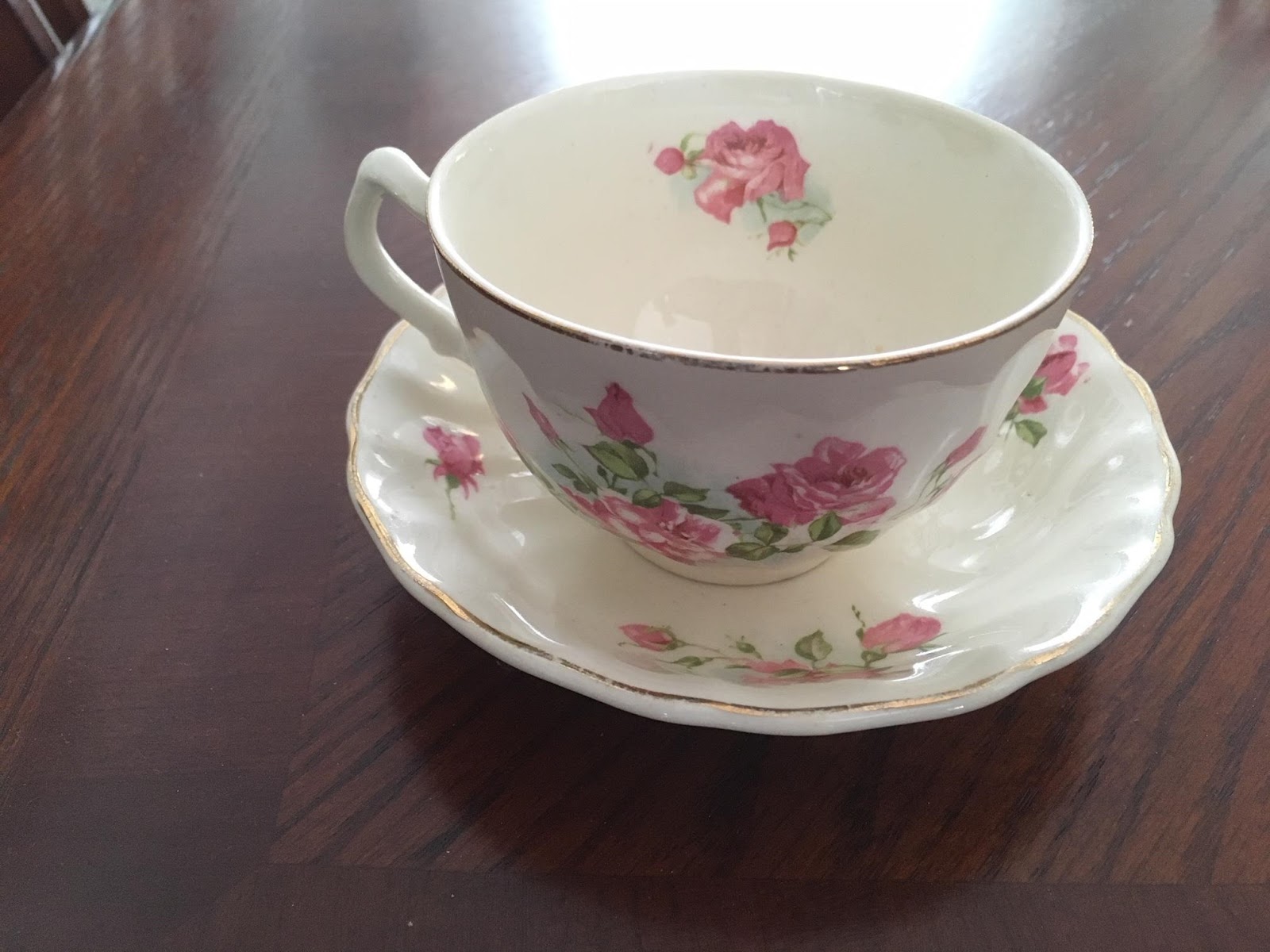
I presently have two sets of china passed along to me by family members.  The set given to me from
my mother is a set composing of pieces she had as well as ones given to her by her grandmother Pearl (nee Mumberson) Bates as she had had the same china pattern.  When I was getting married, I choose my fiance and I choose our own pattern and use that set.  The set from my mother sits in our china cabinet.


Blossom Time
The other set of china I have was given to me by my Aunt Lena (my mother's sister).  As she was getting older, she started to dispose of many of her household items and presented me with the set of her china.  It resides in my china cabinet as well.


Mirror

Every so often, my mother will start going through some of her items and offer them to me.  One such item is a round mirror that had been given to her as a wedding gift in 1949.


Children's Table & Chairs Set

My childhood was spent visiting both sets of grandparents (who lived in the same village) every holiday weekend, as well as extended time at Christmas and summertime.  Quite often, my only female Schell cousin, Mary Lou, who is my age was also visiting at the Schells.  We frequently convinced either our parents or grandparents to retrieve a table and chair set from the attic.  My mother played with the set with her sister during their childhood.

When my grandmother was disposing of the contents of the farm house, I was given the set, as well as a child's rocking chair.